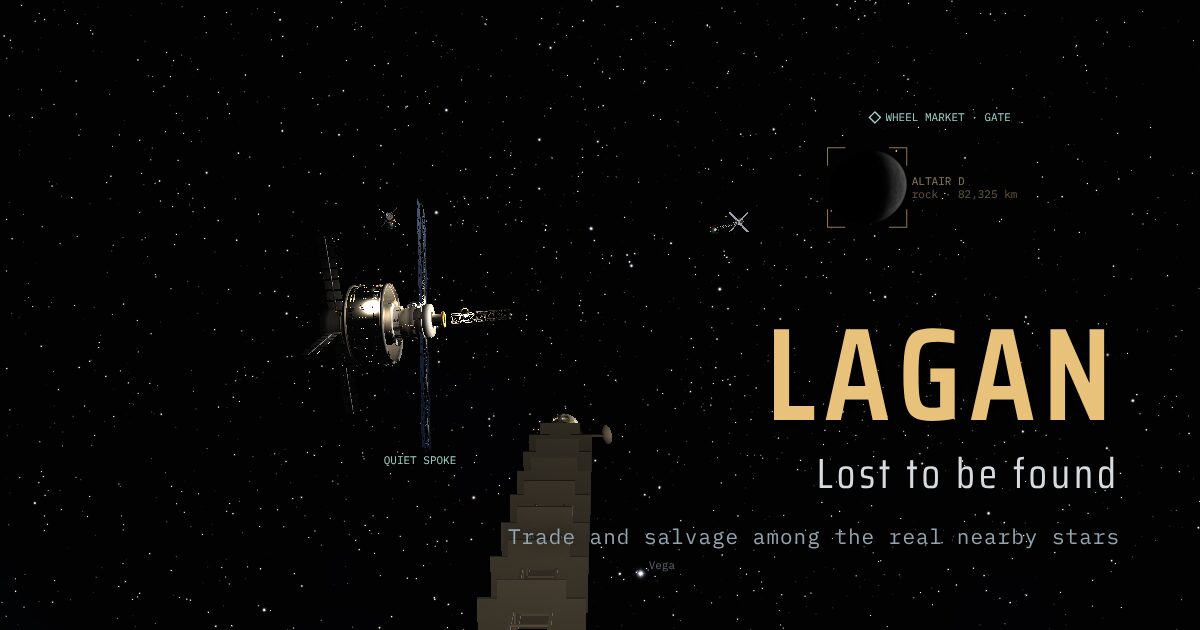
Lagan Lost to be found
A free browser space trading game set among the real stars near the Sun. Trade, salvage wrecks and fight turn by turn in the ruins of a fallen interstellar empire, with a ship's mind for company. Plays on phones.
What is Lagan?
Lagan is a space trading game about making a living in what is left of an interstellar civilisation. You are a captain with a small ship, a hold, a little money and a ship's mind that has opinions. You buy low, sell high, take courier work, pick through wrecks and decide when a fight is worth it.
Lagan is an old word from the law of the sea: goods lost overboard but marked so they could be found and claimed again. In the game, everything worth having was lost once. Your job is to find it.
It is free, needs no download and is built for phones first. It also plays on a tablet or a desktop browser, can be installed to a home screen like an app, and can be played offline.
The setting
Humanity once spread out from the Sun across the nearby stars. Then it fell. The old heart of that space, including Sol itself, is now a ring of ruins: radioactive wrecks, dead stations and automated gunships that still patrol for a war nobody remembers clearly. Pirates and scavengers work the edges.
Further out, a band of younger colonies survived. That is where you start: an inner station of a working system, with no jump drive yet. Nobody agrees on what caused the collapse. Captains trade theories, and the clues are out there in the wrecks.
The tone is bleak but not hopeless. Every trade and every recovered thing helps put something back together.
The real sky
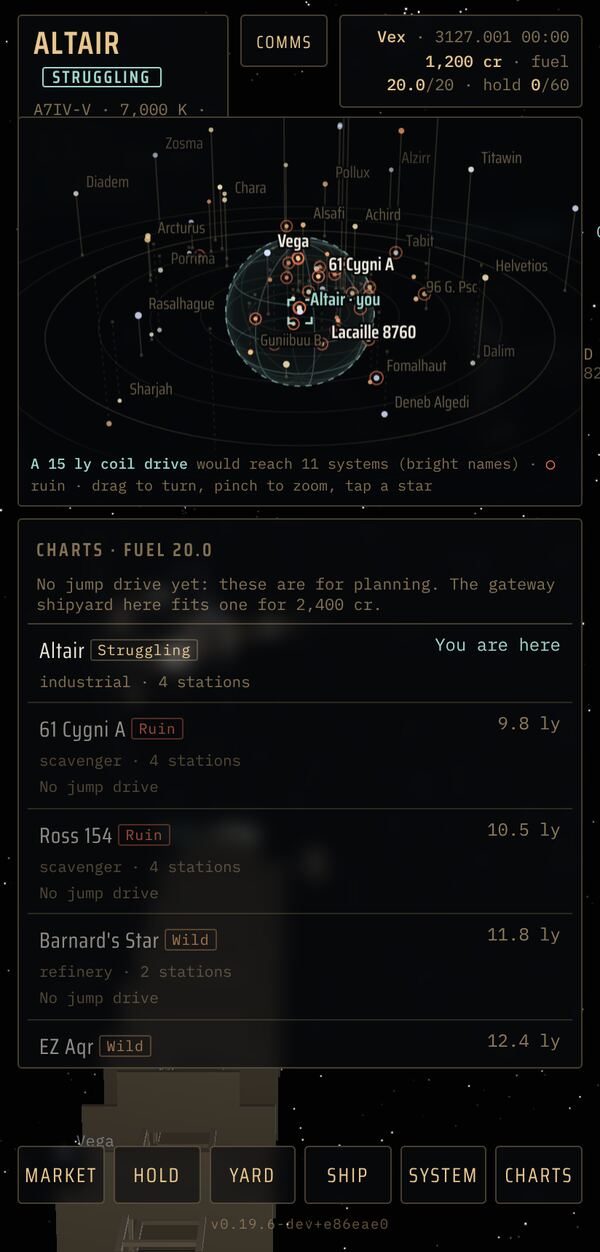
The galaxy is the real solar neighbourhood. The game's 80 star systems are real stars within about 60 light years of the Sun, such as Altair, Vega, Sirius, Tau Ceti, Barnard's Star and 61 Cygni, at their real positions.
The sky you see is drawn from where you are. Fly to Altair and the constellations shift; look back and the Sun is just another faint star. More than 9,000 catalogued stars make up the background. Each system's star has its real spectral class and brightness, and its planets, stations and traffic are generated to fit.
Inside a system the view is true to scale, so most planets are bright dots until you get close. Stations and ships are generated models, lit by the system's own star.
Trade
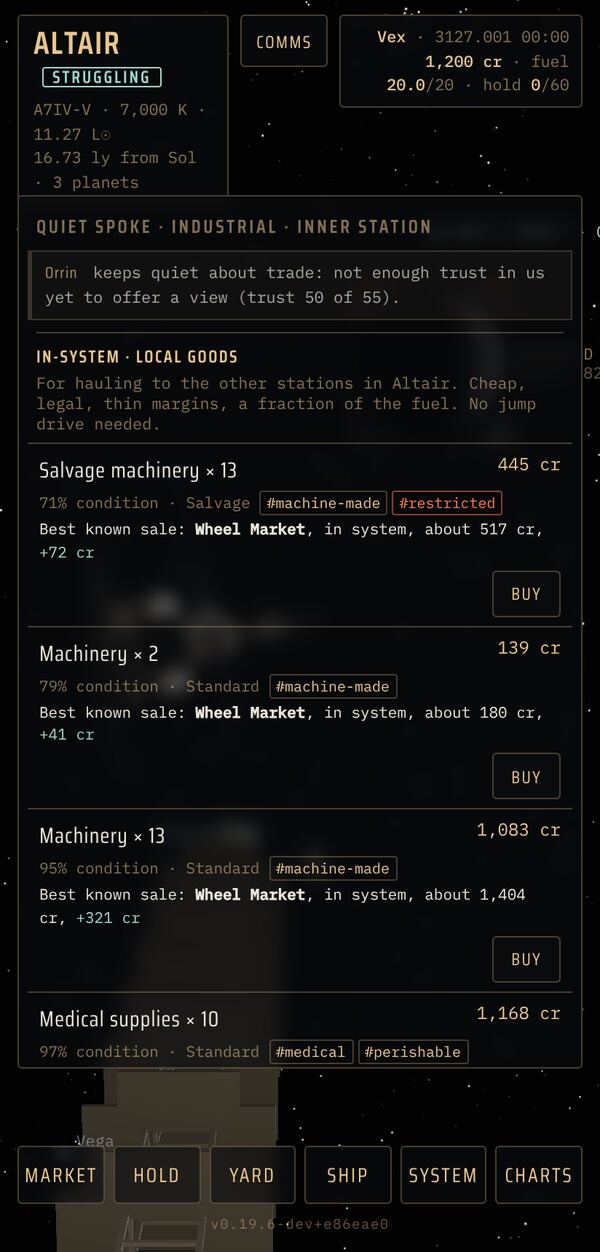
- Every lot is different. Goods come with a condition, a grade and tags such as machine-made, medical, perishable or restricted, and those change what they are worth and who will buy them.
- Local hauls and export runs. Cheap, legal local goods move between stations in one system for a fraction of the fuel. Export goods are worth more and need a jump drive.
- Specialist traders. Collectors and dealers pay a premium for the right sets of goods, and a good sale earns an introduction to the next one.
- Courier and bonded jobs. Broke captains can carry crates for the dock office, and a good reputation unlocks bonded consignments that pay well on arrival.
- A shared economy. Online captains trade in the same markets, so busy routes feel the pressure.
Your ship and its mind
Ships are built from parts you can buy, swap, store and repair at the shipyard: hulls, jump drives, launchers, point defence, sensor arrays, munitions racks and drones. Better kit is found at the inner stations of thriving systems, and some only comes out of wrecks.
Every ship has a mind. It has a personality, a mood and a level of trust in you, and those colour its advice. It will never tell you a false number, but a mind that does not trust you may keep its best ideas to itself. Minds can be recovered from wrecks, woken, and swapped, though not without consequences.
Crew can join you as the story unfolds, if your hull has berths for them.
Salvage
Wrecks are everywhere in the ruined systems. Send a recovery drone in, follow the signals deeper through the structure, and decide how far to push before something notices you. Finds include parts, relics, data cores, sleepers in cryo pods and dormant mind cores. Some jumps stop short beside a dead dreadnought drifting between the stars, a hulk that other captains can find and dig into as well.
Combat without twitch
Fights are turn by turn, with both sides choosing at once. You order the ship: close or open the range, fire a volley of darts, brace, take aim, launch a flare or decoy, hide behind an asteroid, or go dark and hope. Point defence can be swamped, size can be faked and range matters more than anything. It is a sandbox, and captains find tricks. Win, and you can board what is left.
A shared story
Over the endless trading game sits a story the online captains share. Clues turn up in wrecks and in the stations. Captains build a board of theories about the fall, and at turning points they vote on what happens next, and the world changes for everyone. Smaller stories find individual captains along the way.
Captains can talk on an open comms channel or send direct messages.
Play anywhere
- Free, in any modern browser: caravan.logjam.co.uk. Also on itch.io.
- Made for phones first (a Pixel 6 is the minimum target), with power saving built in.
- Install it to your home screen for full-screen play.
- Pick up and play: a session can be a single trade.
- A captain's code moves your captain between devices.
- An offline game, kept on your device, needs no signal.
New to it? Read how to play.